
Contracting Party:
Natural Resources Canada (NRCan), CanmetENERGY-Ottawa
Executive Committee Member
David Ryan
Manager CO2 Storage and Unconventional Resources R&D
CanmetENERGY-Ottawa
Natural Resources Canada
Ottawa, Ontario, Canada

Alternate Member
Andrew Wigston
Geoscientist
CanmetENERGY-Ottawa
Natural Resources Canada
Ottawa, Ontario, Canada
Overview
Canada’s diverse geology creates significant potential for geoexchange, direct use geothermal heat and power generation.
Geothermal research and development is conducted federally by the Geological Survey of Canada and CanmetENERGY, as well as by provincial and territorial geological surveys, universities and industry partners across the country.
Geoexchange
Geoexchange systems are widely used in Canadian homes, multi-unit residential developments, commercial buildings and institutions.
As of 2025, Canada was estimated to have approximately 269,000 residential geoexchange systems, representing 2,601 MWth of installed capacity and supplying around 28,091 TJ of heat annually.
Commercial and institutional systems were estimated to provide a further 2,033 MWth of capacity and approximately 21,959 TJ of heat annually.
Blatchford Renewable Energy Utility
An example is the Blatchford development in Edmonton, Alberta, one of the world’s largest carbon-neutral community projects. The 217-hectare site is designed for approximately 30,000 residents.
Its district energy system combines solar energy with a geoexchange field comprising 570 boreholes drilled to a depth of 150 metres. The system provides heating, cooling and hot water to the community.

Blatchford Renewable Energy Utility, Edmonton, Alberta.
Springhill Mine-Water Project
Springhill, Nova Scotia, is home to what is considered the world’s first commercial mine-water heating and cooling project.Operating since 1998, the system extracts approximately 18°C water from an abandoned coal mine.
It initially served a plastics manufacturer and has since expanded to supply heating and cooling to several municipal buildings, with plans for energy provision to a community greenhouse and college.

Springhill Geothermal Industrial Park.
Direct Use
Canada has considerable potential for direct use geothermal energy, although development remains limited. Current applications are concentrated primarily around recreational hot springs in British Columbia, Alberta and Yukon.
Regina Indoor Aquatics Centre
Regina’s planned Indoor Aquatics Centre is expected to become Canada’s first commercial direct use geothermal project outside the traditional hot-springs sector.

Conceptual design rendering of the Indoor Aquatics Facility (City of Regina).
Geothermal Power
Canada currently has one operating geothermal power project, located at Swan Hills, Alberta.
The hybrid cogeneration facility uses waste heat from a natural-gas turbine to increase the temperature of approximately 100°C water co-produced by oil and gas operations. The facility generates 21 MW of power, with approximately 30% produced from the Organic Rankine Cycle (ORC) plant.
Several new Canadian geothermal projects are also advancing. DEEP Corporation is developing a project in southern Saskatchewan targeting ~120°C brine to generate 30 Mwe, with expansion up to 200 MWe.
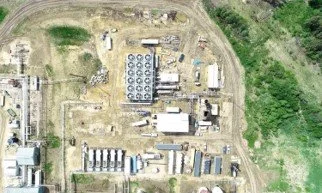
Futera’s co-produced geothermal hybrid power project, Swan Hills, Alberta (Futera).
Next Generation Geothermal
Eavor-Lite

Eavor’s Eavor-Lite Project demonstration project in Rocky Mountain House, Alberta (image from Eavor).
The Derek Riddell Eavor-Lite project near Rocky Mountain House, Alberta, was the world’s first full-scale demonstration of a deep, multilateral closed-loop geothermal system.
The project consisted of two vertical wells completed to a depth of 2.4 kilometres and positioned 2.5 kilometres apart. The wells were connected by horizontal underground sections and a surface pipeline.
Between 2019 and 2024, the project generated more than 20 GWh of thermal energy, achieving uptime of more than 96%. Its successful operation demonstrated the commercial potential of closed-loop geothermal technology.
Federal Geothermal Research and Development
Resource Exploration and Characterization
Natural Resources Canada’s (NRCan) Geological Survey of Canada (GSC) is working to reduce geothermal exploration risk by characterizing Canada’s geothermal systems and comparing them with known geothermal fields around the world. The GSC also aims to identify resources that are the most accessible, reliable and affordable to develop for geothermal heat.
Research, field and laboratory activities cover Western Canada, the Canadian Shield, Arctic regions and areas of Eastern Canada such as Bécancour, Quebec.
The GSC’s research has resulted in Indigenous organisations, industry, the Department of National Defence, and communities actively pursuing geothermal energy exploration and development.
Technology Development and Evaluation
Geothermal Power
NRCan's CanmetENERGY research labs are focused on evaluating and developing geothermal and geoexchange technologies using a combination of bench- and field-scale research and techno-economic modelling.
A significant area of research is evaluating the use of CO₂, instead of or alongside brine, to extract heat from hot sedimentary aquifers to generate carbon-negative power.
There is significant potential to deploy this technology in large parts of Western Canada if proven viable.
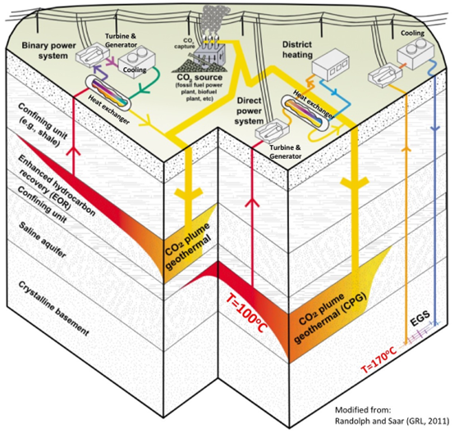
CO2 geothermal concept.
Geoexchange
CanmetENERGY-Ottawa is evaluating the techno-economic feasibility of deep borehole heat-exchange systems for northern communities that currently depend on diesel for heat and electricity.
CanmetENERGY-Varennes has also developed a CO₂ direct-expansion ground-source heat-pump system. The technology uses CO₂ within both the borehole heat exchanger and the heat-transfer system. Recent research has demonstrated it can increase the coefficient of performance by up to 18%.

Working CO2 DX GSHP system connected to Varenne’s HVAC system.
Field Research Projects
There are a number of geoexchange and geothermal field-based research projects in Canada.
Durham College Energy Innovation Centre
A living laboratory developed with Siemens Canada, featuring 150 boreholes drilled to a depth of 180 metres for research into seasonal energy storage.
C-FER
Large-scale facilities for testing geothermal tools, well casings, cements and other equipment under high pressure and high temperature conditions.
University of Waterloo
A low- to medium-temperature geothermal research facility focused on seasonal heat storage, waste-heat use and integration with technologies including compressed-air energy storage, wind and solar power.
INRS–LIST
A geoexchange field site operated by the Institut National de la Recherche Scientifique (INRS) in Quebec City for research and teaching.
Alberta Drilling Accelerator
A proposed open-access drilling site where geothermal and other subsurface industries can test technologies at deep depths under high pressure and temperature conditions.

Annual Reports
Contact:
David Ryan
Manager CO2 Storage and Unconventional Resources R&D
CanmetENERGY-Ottawa
1 Haanel Drive
Ottawa, Ontario, Canada
K1A 1M1